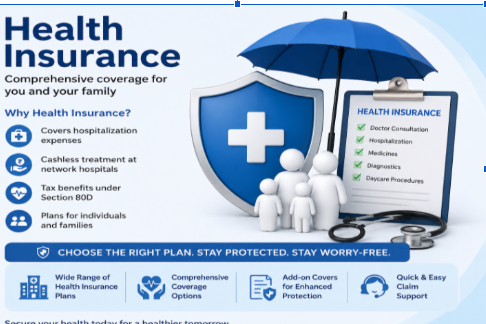
Medical treatment can involve significant expenses, particularly when hospitalisation or surgery is required. During such situations, arranging a large amount of money while also managing medical decisions can add financial stress to an already difficult experience.
For individuals and families evaluating a health insurance plan, understanding how the cashless facility works can help them make a more informed decision.
What Is Cashless Health Insurance?
Cashless health insurance is a facility through which an insured person can receive eligible treatment at a network hospital without having to pay the entire covered hospital bill upfront. Cashless health insurance can make the payment process more manageable by allowing eligible expenses to be settled directly between the insurer and a network hospital, subject to policy terms and claim approval. can make the payment process more manageable by allowing eligible expenses to be settled directly between the insurer and a network hospital, subject to policy terms and claim approval.
The hospital generally coordinates with the insurer or its authorised claims administrator to process the claim. Once the claim is approved, eligible expenses are settled directly with the hospital according to the policy conditions.
However, cashless treatment does not mean that every hospital expense will be paid by the insurer. The policyholder may still have to pay amounts relating to exclusions, deductibles, co-payments, non-medical expenses or costs that exceed the available coverage.
How Does the Cashless Facility Work?
The cashless process generally involves several steps. The exact procedure can differ between insurers and hospitals, but the basic process remains similar.
Step 1: Visit a Network Hospital
The insured person generally needs to visit a hospital included in the insurer’s network for cashless treatment.
It is useful to check the network hospital list before an emergency occurs. Knowing which hospitals near your home or workplace provide the facility can save time during an urgent situation.
Step 2: Submit Insurance Details
At the hospital’s insurance desk, the patient or family member provides the required insurance and identification details. The hospital may also request medical documents related to the treatment.
Step 3: Pre-Authorisation
For planned hospitalisation, the hospital generally submits a pre-authorisation request before treatment. For emergencies, the request may be initiated after admission according to the applicable process.
The insurer reviews the request and determines whether the treatment appears to fall within the policy’s coverage.
Step 4: Claim Approval
The claim is assessed based on the policy’s coverage, waiting periods, exclusions, available sum insured and other applicable conditions. If approved, the insurer communicates the authorised amount to the hospital.
Step 5: Settlement
After treatment, the insurer settles the approved eligible amount directly with the hospital. The policyholder pays any applicable amount that falls outside the approved coverage.
Cashless and Reimbursement Health Insurance Claims
Cashless and reimbursement are two different ways of processing a health insurance claim.
| Feature | Cashless Claim | Reimbursement Claim |
| Initial hospital payment | Eligible approved expenses are generally settled directly with the hospital | Policyholder generally pays the hospital first |
| Hospital requirement | Usually requires a network hospital | Depends on policy conditions |
| Claim initiation | Hospital generally coordinates with insurer | Policyholder submits claim documents |
| Immediate financial requirement | Lower for covered approved expenses | Higher because payment is initially made by the policyholder |
| Documentation | Hospital assists with claim documentation | Policyholder generally collects and submits documents |
Both methods are subject to the policy terms and claim approval.
Why Is Cashless Health Insurance Useful?
One of the main advantages of a cashless facility is that it can reduce the need to arrange the entire eligible hospital bill immediately.
During an emergency, families may already be dealing with transportation, medical decisions and communication with doctors. Having a cashless facility can reduce one part of the financial process.
It may also help families preserve their available savings for expenses that are not covered by the policy.
What Expenses May Not Be Covered?
A cashless facility does not mean that the entire hospital bill will necessarily be settled by the insurer.
Depending on the policy, the patient may need to pay:
- Deductibles
- Co-payment
- Non-medical expenses
- Excluded treatments
- Expenses above the sum insured
- Costs exceeding applicable sub-limits
- Charges resulting from room-rent restrictions
For this reason, policyholders should understand their coverage before assuming that no payment will be required at the time of discharge.
What Should You Check Before Selecting a Health Insurance Plan?
When evaluating a health insurance plan, consider more than the availability of cashless treatment.
Network Hospitals
Check whether the insurer has network hospitals in locations that are convenient for you and your family. Also verify whether hospitals you regularly prefer are included.
Sum Insured
Consider potential healthcare costs and choose a sum insured that is appropriate for your circumstances. A larger family or a family living in a city with high medical costs may require different coverage from a single individual.
Waiting Periods
Understand the waiting periods applicable to pre-existing conditions, specific illnesses and treatments.
Room Rent Limits
Check whether there is a limit on room rent and how it may affect the overall claim.
Co-Payment
A co-payment means that the policyholder has to bear a specified portion of eligible expenses. This condition should be considered while comparing plans.
Exclusions
Read the policy exclusions carefully to understand which expenses will not be covered.
Claim Support
Review the insurer’s process for cashless and reimbursement claims. Easy access to claim information can be particularly useful during hospitalisation.
Cashless Treatment for Planned Hospitalisation
The cashless facility can be particularly convenient when treatment is scheduled in advance.
Before planned admission, policyholders can:
- Confirm the hospital’s network status.
- Inform the hospital about the insurance policy.
- Submit the required pre-authorisation request.
- Carry identification and policy documents.
- Confirm the expected treatment and applicable coverage.
- Keep funds available for expenses outside the policy.
Planning these steps in advance can reduce uncertainty during admission.
Cashless Treatment During an Emergency
Emergencies may not allow families enough time to research hospitals or complete formalities beforehand. If the patient is taken to a network hospital, the hospital’s insurance desk can generally initiate the applicable cashless process.
The insurer will assess the request according to the policy conditions. Emergency cashless approval may therefore depend on factors such as the patient’s treatment, policy validity, available coverage and applicable exclusions.
If cashless approval is not available or the hospital is not part of the network, reimbursement may be possible if the policy allows it.
Keep Your Insurance Information Accessible
Having health insurance is only useful if you can access the relevant information when required. Keep a digital copy of your policy document, insurance card and important contact details on your phone or another secure location.
Family members should also know where these details are stored. This can be especially useful if the policyholder is unable to manage the paperwork during an emergency.
Choosing Health Insurance With Practical Protection
Cashless health insurance can make hospitalisation financially easier to manage by reducing the need to arrange the entire eligible hospital bill upfront. However, its usefulness depends on the underlying health insurance plan, network hospitals, coverage limits and claim conditions.
When selecting a health insurance, review the sum insured, waiting periods, exclusions, room-rent limits, co-payment requirements and network hospital availability. Understanding these conditions can help you avoid unexpected financial obligations during treatment.
A cashless facility is therefore not simply a payment convenience. It can be an important part of how a health insurance plan works during hospitalisation, particularly when families need timely access to medical care without arranging the entire covered amount from their own funds.