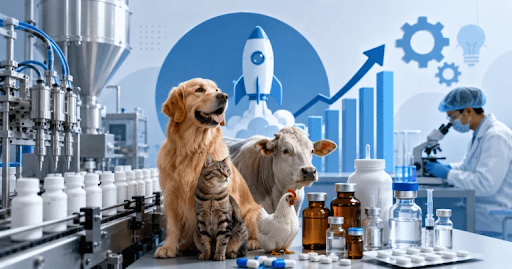
The animal health market in India continues to grow, driven by dairy, poultry, and rising pet ownership. This growth has created opportunities for people who want to build a business in the veterinary sector without setting up their own factory.
One of the most common routes is the veterinary PCD pharma franchise model. This guide explains what it is, how it works, and what to look for when choosing a veterinary pharma franchise company.
What is a veterinary PCD pharma franchise?
PCD stands for Propaganda Cum Distribution. In simple terms, a veterinary PCD pharma franchise lets an individual or small business sell a company’s branded veterinary products in a defined area.
The franchise partner does not manufacture anything. The parent company supplies ready-made, branded products, and the partner focuses on selling them to veterinarians, dealers, and farmers in their territory.
How the PCD model works
The model is popular because it lowers the barrier to entry. You get an established product range without the cost and complexity of production.
Products and branding
The company provides finished products under its own brand, along with packaging and promotional material.
Monopoly rights
Many companies offer monopoly rights, meaning you are the only franchise partner selling those products in your area. This reduces internal competition.
Marketing support
Partners often receive visual aids, product literature, and samples to help with local promotion.
Your role
You build relationships with local vets, dealers, and farmers, and manage sales in your region. Your local knowledge is the main driver of success.
Why entrepreneurs choose a veterinary pharma franchise company
The PCD model suits people who want a lower-risk entry into pharma. The benefits are practical.
- Low investment compared with building a manufacturing unit.
- A ready product range, so you can start selling quickly.
- Monopoly rights that protect your territory in many cases.
- Marketing and product support from the parent company.
- Flexibility to grow your territory as your network expands.
For example, a distributor who already supplies feed or veterinary products can add a PCD franchise to offer a branded range and earn better margins.
What you need to start
Starting a veterinary PCD pharma franchise is simpler than many people expect, but a few basics help.
- Basic knowledge of, or contacts within, the local animal health market.
- A drug licence and GST registration, as required for pharma distribution.
- Modest working capital for your initial product order.
- Time and effort to build local relationships and follow up regularly.
The partners who do best are usually those who work their territory consistently rather than expecting sales to arrive on their own.
How to choose the right franchise partner
The company you partner with affects your daily business, so choose carefully.
- Certification: Confirm WHO-GMP or cGMP manufacturing.
- Product range: A wider range gives you more to sell.
- Monopoly rights: Check whether exclusive territory is offered.
- Supply reliability: Late restocking costs you customers.
- Support: Marketing material, product training, and responsive service all help.
Vetset Lifecare: an example
Vetset Lifecare offers veterinary PCD franchise opportunities across India. As a WHO-GMP certified company based in Ambala, Haryana, it provides branded products, monopoly rights, marketing support, and product training to franchise partners.
Its range covers livestock, poultry, dairy, and pet care segments. As with any business decision, it is one option among several, and partners should compare terms based on their own goals.
How PCD franchise earnings usually work
In a PCD franchise, your income comes from the margin between the price you pay the company and the price at which you sell to vets, dealers, or farmers.
Because veterinary products often see repeat demand, a well-worked territory can generate steady, recurring income rather than one-off sales. A dairy region, for example, needs regular supplies of calcium and mineral products throughout the year.
Your earnings depend heavily on effort. Partners who visit customers regularly and build trust usually see better results than those who wait for orders to come to them.
PCD franchise vs distributorship
People sometimes confuse these two models. The difference is simple.
- A distributor usually stocks and supplies products across a wider area, often for several brands, with larger volumes.
- A PCD franchise partner focuses on a specific brand in a defined territory, often with monopoly rights and marketing support.
PCD suits those who want a closer partnership with one company and support to build a brand locally. Distributorship suits those who prefer volume-based supply across a broader area.
Common questions before starting
People entering the sector usually have a few practical concerns.
- Do I need experience? Some background in the animal health market helps, but it is not always essential.
- How quickly can I start? Once documentation and the first order are complete, you can usually begin fairly quickly.
- What products sell best? This depends on your region; dairy areas differ from poultry-focused ones.
- Is support provided? Good companies offer product training and marketing material to help you begin.
Tips for growing a veterinary PCD franchise
Getting started is one thing; growing steadily is another. A few practical habits make a real difference to how a franchise performs.
- Build relationships, not just sales. Regular visits to vets, dealers, and farmers build trust that leads to repeat orders.
- Know your territory. Understand which products your local farmers actually need, whether dairy, poultry, or mixed.
- Keep stock ready. Running out of a popular product sends customers to competitors.
- Use the support provided. Marketing material, product training, and samples help you promote effectively.
- Track what sells. Focus on your best-performing products and plan orders around seasonal demand.
For example, a partner in a dairy region may find that calcium and mineral products sell steadily throughout the year, while demand rises around calving season. Planning stock around these patterns keeps customers satisfied.
Growth in this business is usually steady rather than sudden. The partners who succeed treat it as a long-term relationship with both their customers and the parent company. Consistency and follow-up, more than anything else, are what turn a new franchise into an established local name.
Conclusion
A veterinary PCD pharma franchise offers a practical, lower-risk way to enter India’s growing animal health market. You sell established products in your area while the company handles manufacturing and branding.
When selecting a veterinary pharma franchise company, focus on certification, product range, territory rights, and support. A well-matched partner gives your business a strong foundation to grow.
Frequently Asked Questions
What is a veterinary PCD pharma franchise?
A veterinary PCD pharma franchise lets an individual or business sell a company’s branded veterinary products in a defined territory. The partner handles local sales while the company provides finished, branded products and support.
How much investment does a veterinary PCD franchise need?
Investment is generally low compared with setting up a factory, usually limited to an initial product order and basic working capital. Exact amounts depend on the company, product range, and territory.
What support does a veterinary pharma franchise company provide?
Companies typically provide branded products, monopoly territory rights, marketing material, product training, and ongoing supply. The level of support varies, so it is worth comparing partners before deciding.
Can I start a veterinary PCD franchise with Vetset Lifecare?
Yes. Vetset Lifecare offers veterinary PCD franchise opportunities across India, providing WHO-GMP certified products, monopoly rights, marketing support, and product training across livestock, poultry, dairy, and pet care segments.


