Aisha had an idea for a peer tutoring marketplace. Students at her university post subjects they need help with, other students bid to tutor them, and the platform takes a small cut of each session fee. The concept was sound. Her immediate circle of friends thought it was great. Her problem was that she had no idea whether anyone outside her immediate circle would actually use it, and she didn’t want to spend six months and a significant amount of borrowed money building something that might turn out to have no real demand.
What she needed wasn’t the finished product. She needed the fastest, most affordable version of the product that could tell her whether the demand existed. That’s what an MVP is for, and finding the right mobile app development services to build one means looking for a team that understands the distinction between building to validate and building to last. They’re genuinely different projects, and teams optimized for one often aren’t optimized for the other.
What an MVP Is and What It Isn’t
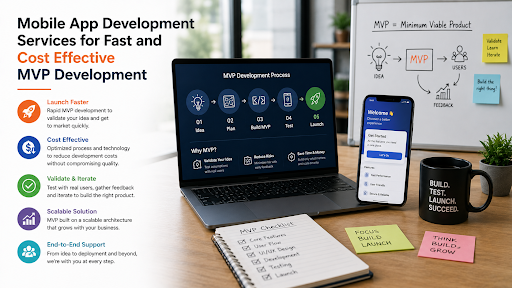
Minimum Viable Product has been so thoroughly absorbed into startup vocabulary that it’s worth being precise about what it actually means in the context of a mobile app build. An MVP is not a rough version of the full product with some features removed. It’s a specific, deliberate answer to a specific, deliberate question: is there evidence that enough people have this problem, want this solution, and will take some meaningful action, paying money, signing up, inviting others, to indicate that building the full product is worth the investment?
An MVP doesn’t need every feature. It needs the features that, if people use them, answer the validation question. For Aisha’s tutoring marketplace, the validation question was: will students post tutoring requests, and will other students respond to them? Everything else, sophisticated matching algorithms, in-app video sessions, detailed rating systems, could come later if the answer was yes. The MVP needed to test the posting and responding behavior, nothing more.
Teams that resist scope in this way, that push back when a founder wants to add features that don’t serve the validation question, are the teams most useful for MVP work. Teams that build whatever the client specifies, without engaging with whether those specifications serve the underlying goal, tend to produce MVPs that are really just smaller versions of full products, which costs more, takes longer, and often still doesn’t answer the question.
The Technical Choices That Actually Affect MVP Speed
Cross-platform frameworks are almost always the right choice for an MVP build. Flutter and React Native both let a single codebase cover iOS and Android simultaneously, which removes the timeline cost of building twice for teams that want to reach users on both platforms without sequencing it. For a validation project, reaching a larger and more diverse user base faster matters more than the marginal performance advantages of native development.
Backend-as-a-service platforms like Firebase, Supabase, or AWS Amplify remove significant infrastructure work from the early build by providing authentication, real-time database, file storage, and serverless functions as managed services. An MVP backend that would take weeks to build from scratch takes days with these tools, and the trade-off, higher per-use costs at scale, is irrelevant at validation stage since the point is to reach scale at all.
No-code and low-code tools for specific non-core parts of the build, Stripe for payments, Twilio for SMS notifications, Sendgrid for email, Algolia for search, reduce the development time for standard functionality that doesn’t need custom implementation. An experienced MVP-focused team knows which parts of a product to build custom and which to assemble from reliable third-party services.
What Speed Actually Requires From the Client Side
Fast MVP development requires fast decisions. A six-week MVP build that pauses for two weeks while the client deliberates on a design choice is an eight-week build. Teams that do MVP work well will tell you that the biggest timeline variable isn’t their velocity; it’s how quickly the client can make decisions and provide feedback during the build.
The most useful client preparation before an MVP build starts is a clear priority list: if we can only build three things, what are they, and in what order. A team can move fast on a clear brief. They slow down when requirements are still being worked out during the build, not because they’re inefficient but because building on an uncertain foundation produces rework.
Aisha had done this work before her first call with development teams. She knew her validation question, knew the three features required to answer it, and knew what success would look like at the end of a six-week period. That preparation made her a significantly faster client than someone with a good idea but no prioritization done.
Breaking Down What It Actually Costs
MVP development cost scales with scope, team location, and timeline compression. A genuinely minimal MVP, three to five core screens, basic authentication, one or two primary user flows, and a simple backend on Firebase or Supabase, can be built by a quality South Asian or Eastern European team in four to eight weeks for $15,000 to $40,000. Adding complexity, more user types, a custom backend, third-party integrations, pushes the number upward accordingly.
North American and Western European teams at the same scope run $35,000 to $80,000, with the rate difference primarily reflecting hourly costs rather than output quality. The right choice depends on the founder’s available budget, the complexity of the required integrations, and how much ongoing communication bandwidth the team requires.
The cost of not building an MVP is harder to quantify but consistently larger: a full product build that discovers the demand problem after launch rather than before is the most expensive version of the validation question. The MVP isn’t a cost; it’s an insurance premium against a much larger potential loss.
What Happens After the MVP
An MVP that validates demand creates a new set of questions. Which features do users actually use versus which ones were assumed to matter? What’s the retention curve, and what does it tell you about whether users find lasting value? What are users asking for that isn’t in the product? The answers to these questions, not the original product specification, should drive what gets built next.
This is why MVP architecture decisions matter more than they sometimes seem. An MVP built on a clean, maintainable foundation can be extended incrementally as validation results come in. An MVP built entirely on technical debt to hit a deadline creates a second project, a rebuild, before the real product work can begin. The balance between speed and maintainability isn’t always obvious, and it’s one of the more nuanced judgment calls in MVP-focused development work.
What Aisha’s MVP Looked Like
She launched six weeks after signing the contract. The app had posting, browsing, and a simple in-app messaging flow. No payments yet. No sophisticated matching. Just enough to see whether the behavior existed. In the first three weeks, forty-seven students posted tutoring requests and twenty-two others responded to at least one. Twelve sessions were coordinated through the app using external payment methods since the payment feature hadn’t been built yet.
That was her answer. She raised a small friends-and-family round the following month based on those twelve sessions and started scoping the full build. The MVP cost her $22,000 and six weeks. The full product would have cost eight times that and taken eight months. She would have spent that money and time not knowing whether those forty-seven students would show up.
They did. But the MVP told her that before she spent the rest of the money.

