Why Do Many Authors Find It Difficult to Choose a Publishing Path?
A successful completion of a manuscript can be quite an accomplishment; however, finding out what kind of publishing will work for your purposes is just as difficult. Numerous Australian writers have problems with choosing whether to go with self-publishing or traditional publishing. Each of these methods has its own benefits; however, each of them also requires a number of responsibilities from an author.
To find out which one would fit you the most, you should consider such aspects as control over your manuscript, money needed for your project, your time frames for publishing, your expectations for marketing, and your financial purposes.
This guide reveals all the peculiarities of self-publishing and traditional publishing.
What Is Self-Publishing?
Self-publishing is when authors get published without signing a deal with a publishing company by making decisions on their own. The author is involved in all stages of the publishing process – from editing to distribution and marketing.
It may be said that self-publishing makes the author responsible for many things but also grants them full control of their book.
Self-publishing has gained popularity due to the fact that today publishing technologies allow authors to create top-notch books.
What Is Traditional Publishing?
The process of traditional publishing entails submission of the manuscript to the publishing firm. If accepted by the publisher, most of the editing, design, printing, distribution, and some of the marketing processes will be undertaken by the publishing firm.
As publishers make investment in the creation of the book, they are known to consider the manuscripts very seriously before making any offer of the publishing deal.
This implies that the process can be highly competitive and may require a lot of patience.
How Do Self-Publishing and Traditional Publishing Compare?
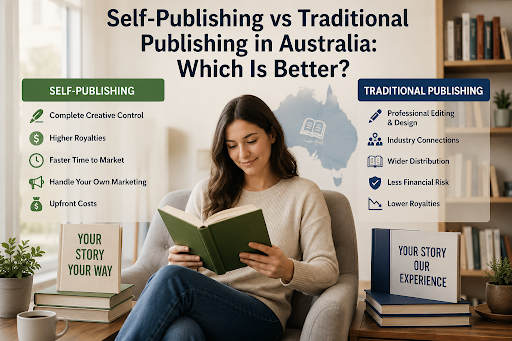
| Feature | Self-Publishing | Traditional Publishing |
| Creative Control | Full control | Jointly controlled by the publisher |
| Publication Time | Much faster | Much slower, taking months or even longer |
| Royalties | Higher percentage per sale | Lower percentage per sale |
| Upfront Costs | Costs incurred by the author | Publisher usually covers costs |
| Distribution | Decided by the author | Managed by the publisher |
| Editing & Design | Managed by the author | Managed by the publisher |
| Ownership | The author owns the copyright in most cases | Ownership can be joint with the publisher |
Before reaching the final conclusion, it is advisable to assess the overall vision of the authors concerning the process of publication. There are authors who would like to have full control over their creation, the ability to release subsequent editions as and when they wish, whereas some authors may appreciate having professional assistance along the entire path of publication. Other considerations include the target audience, plans for distribution, budget, and desire to take care of marketing issues. In this way, understanding of both approaches will assist authors in overcoming all sorts of problems.
Which Option Gives You More Creative Freedom?
Many authors would like to be able to control everything about their book. This control could include the title, cover art, interior design, price point, date of release, and any changes in the future.
Self-publishing allows for this kind of flexibility because the author controls all these aspects at all stages of the publishing process. They can alter their book and their marketing strategy as their readership expands.
In traditional publishing, there is more likely to be some editing and other suggestions from the publishing house.
Which Publishing Route Is Faster?
The time required to publish the book differs significantly from one of the choices to another.
Self-publishing means that an author can publish the book once the editing, formatting, and production of the book have been completed. It can be accomplished within a matter of weeks or months depending on the extent of preparation.
Publication through traditional publishers involves submission of a manuscript, reviewing, negotiating contracts, editing, production, and release dates of the book, which makes the process lengthy.
Writers who wish to publish their books faster usually value the options provided by the best publishing companies.
Which Option Offers Better Financial Returns?
Considerations such as income also need to be taken into account when selecting a publishing model.
An author who publishes their work individually will receive better royalties per book sold, since he/she receives a bigger part of income from selling the book. Yet, such an author pays out of his/her own pocket for all kinds of expenses involved in producing the book.
A traditional publisher bears all those expenses in exchange for getting lower royalties.
All of that will depend on the author’s selection of a publishing model as well as on other factors.
Which Publishing Path Is Better for First-Time Authors?
No one-size-fits-all solution exists here.
First-time authors who appreciate the help of publishing companies for novels may be those who need professional assistance at every stage of editing, publishing, and marketing the novel.
On the other hand, there are some authors who like to learn the whole procedure of publishing by themselves so that they do not lose any control over their product.
This will depend on you and your abilities, finances, and desire to be involved in the entire procedure of book publishing.
How Can Authors Improve Their Chances of Success?
Quality is always what matters in whatever method is used.
Proper editing ensures quality content, proper formatting gives quality look, and a good cover creates a positive impression. Proper marketing, audience communication and proper planning are also essential in achieving quality publishing.
Authors who intend to self publish their books will find a Self Publish Book Printing service helpful for professional quality production and proper flexibility.
Ready to Choose the Right Publishing Path?
Whether you would like to have total control over your creativity or professional assistance in publishing, getting familiar with your choices can be your first step toward making a firm decision. Check out your publishing alternatives at www.bookpublisher.au.
Conclusion
Both forms of publication have their advantages for Australian writers. The self-publication mode gives more control, quick publishing process, and higher royalties, while the traditional form of publishing is backed up by professionalism, industry contacts, and experience.
Your decision on which one is right for you will be based on what works well for you. Through an assessment of the benefits of both modes of publication, you will choose the most appropriate one for your publishing process.