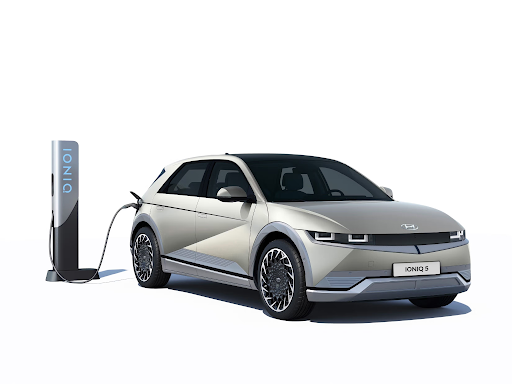
Fast charging helps electric vehicle (EV) owners recharge their batteries in less time, making longer journeys easier to plan. The Hyundai CRETA Electric and Hyundai IONIQ 5 support DC fast charging, but their battery capacities and charging times differ. Understanding how the technology works and what each model offers can help drivers plan charging stops more effectively.
How Does DC Fast Charging Work?
An electric car stores energy in a high-voltage battery. AC chargers supply alternating current, which the car converts into direct current for storage. A DC fast charger supplies direct current to the car’s battery system, allowing faster charging.
The car and charger communicate to regulate power based on the battery’s condition and charging limits. Charging speed also changes during a session. The battery generally accepts more power at lower charge levels, while charging slows as it approaches a higher level. This helps manage battery temperature and performance.
How Fast Does the Hyundai CRETA Electric Charge?
The Hyundai CRETA Electric comes with two liquid-cooled lithium-ion battery options: 42 kWh and 51.4 kWh. It supports CCS2 DC fast charging.
According to Hyundai’s published specifications, the CRETA Electric can charge from 10% to 80% in approximately 39 minutes using a compatible DC charger rated above 100 kW and 400 V.
The Hyundai CRETA Electric also supports AC charging, including a 7.4 kW wallbox option. AC charging takes longer than DC fast charging, making DC charging useful when owners need to recharge during a journey.
The stated 39-minute charging time is an estimate under specified conditions. Actual results depend on the charger’s output, battery temperature and starting charge level. The charger’s maximum rating does not mean the car will receive that power throughout the session.
How Fast Does the Hyundai IONIQ 5 Charge?
The Hyundai IONIQ 5 features an 84 kWh liquid-cooled lithium-ion battery and a battery heating system. Its E-GMP platform supports high-power DC fast charging.
Hyundai states that the IONIQ 5 can charge from 10% to 80% in approximately 18 minutes when connected to a compatible 350 kW DC charger. This is a manufacturer-stated estimate under specified conditions, not a guaranteed charging time at every station.
A lower-powered charger can still charge the car, but the session will take longer. Battery temperature, the starting charge level and the power available at the station can also affect charging time.
How Do the CRETA Electric and IONIQ 5 Compare?
Both models support CCS2 DC fast charging, but their battery capacities and published charging times differ.
| Feature | Hyundai CRETA Electric | Hyundai IONIQ 5 |
| Battery capacity | 42 kWh or 51.4 kWh | 84 kWh |
| Battery type | Liquid-cooled lithium-ion | Liquid-cooled lithium-ion |
| Published 10%–80% charging time | Around 39 minutes | Around 18 minutes |
| Stated DC charging condition | Compatible charger above 100 kW and 400 V | Compatible 350 kW DC charger |
These figures reflect Hyundai’s stated charging conditions. Actual charging times may vary with the station, battery condition and operating conditions.
What Affects Hyundai EV Fast Charging Time?
Several factors influence how quickly an EV battery recharges.
- Charger output: The charging station must provide compatible power. A lower-output charger will generally take longer to charge the car.
- Battery charge level: Charging often slows as the battery approaches a higher charge level.
- Battery temperature: Very hot or cold conditions can affect how quickly the battery accepts energy.
- Power availability: The station may deliver less power than its maximum rating because of operating limits or power sharing.
- Vehicle charging limits: The car regulates incoming power to protect the battery and keep it within safe operating conditions.
These factors explain why two charging sessions may take different amounts of time, even when the same car is used.
How Can Owners Plan DC Fast Charging in India?
For DC fast charging in India, owners should confirm the charging station supports the car’s CCS2 connector and offers sufficient charging power.
Before setting off, check the station’s availability, operating status and payment requirements. Hyundai’s myHyundai app can help users locate charging points. Charging network apps may also provide details about available connectors and charger output.
For longer journeys, identify suitable charging stops along the route and keep an alternative station in mind. Allow extra time for queues or changes in charging speed. It is also useful to check the car’s remaining range before deciding where to stop.
Final Thoughts
Hyundai’s DC fast-charging technology lets CRETA Electric and IONIQ 5 owners recharge during longer journeys. Hyundai estimates charging from 10% to 80% takes around 39 minutes for the CRETA Electric and 18 minutes for the IONIQ 5 under specified conditions. Choosing a compatible charger and accounting for battery temperature and station output helps drivers plan realistic charging stops.

