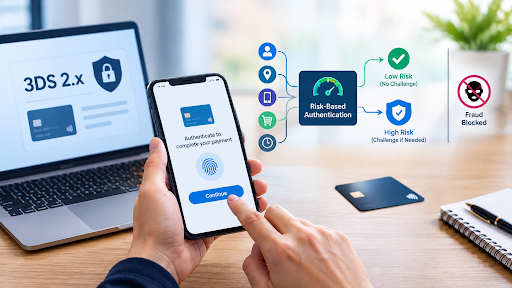
Digital payment authentication works best when security matches each transaction’s risk level. 3D Secure authentication supports this approach by enabling issuers to assess transaction data and choose an appropriate authentication flow. With risk-based authentication, banks can identify lower-risk transactions for frictionless authentication while directing higher-risk activity toward additional verification. This approach can reduce unnecessary challenges while keeping fraud prevention central to the payment journey.
Why Do High 3DS 2.x Challenge Rates Create Payment Friction?
EMV 3DS supports frictionless and challenge flows. In a frictionless flow, the issuer authenticates the cardholder through real-time risk assessment. A challenge flow asks the cardholder for additional verification, which may involve methods such as a one-time passcode or biometric authentication.
Challenges play an important role when transaction risk warrants extra verification. Applying them selectively helps legitimate customers complete purchases with fewer steps. This gives issuers an opportunity to support a smoother checkout experience while maintaining appropriate authentication controls for higher-risk activity.
How Does Risk-Based Authentication Reduce Unnecessary Challenges?
Risk based authentication evaluates relevant information about each transaction before determining the appropriate authentication path. The assessment can consider transaction details, cardholder information, the device used, transaction history, merchant relationships, and technical information such as device location or IP address.
When available information indicates lower risk, the issuer can authenticate the cardholder through a frictionless flow. Transactions with elevated risk can move to a challenge flow for additional verification. This risk-sensitive approach directs authentication effort toward transactions that merit closer review.
How Can Banks Reduce Challenges While Maintaining Fraud Controls?
Banks can align challenge decisions with the risk presented by each transaction. Real-time assessment gives the issuer’s Access Control Server (ACS) the information it needs for authentication decisions, allowing lower-risk activity to receive a frictionless experience while higher-risk activity receives additional verification.
Selective challenges also help institutions concentrate stronger authentication on activity that displays elevated risk. As transaction patterns and fraud tactics evolve, banks can refine authentication rules and risk models using observed outcomes, supporting an effective balance between payment security and customer experience.
Which Risk Signals Help Improve Authentication Decisions?
Several data points can contribute to a more informed view of transaction risk, such as:
- Transaction Details: Amount, currency, merchant information, and transaction type provide context for evaluating the payment.
- Device Information: Device-related data can help issuers understand the transaction environment.
- Transaction History: Previous cardholder activity can provide useful context when assessing current payment behavior.
- Technical Signals: Device location and IP address can add further context to the issuer’s real-time assessment.
Using multiple relevant signals gives issuers a broader basis for deciding which authentication path suits each transaction.
How Should Banks Balance Challenge Rates And Fraud Risk?
Banks can assess authentication performance by reviewing several related indicators together, including:
- Challenge Outcomes: Review how customers complete challenges and identify opportunities to improve authentication decisions.
- Fraud Outcomes: Track confirmed fraud across authentication flows to evaluate the effectiveness of current risk controls.
- Risk Thresholds: Tune decision thresholds as transaction behavior, fraud patterns, and risk conditions evolve.
- Customer Experience: Assess authentication journeys alongside security outcomes to support efficient payment experiences.
Regular performance reviews can help banks keep authentication decisions aligned with changing customer behavior and fraud risk.
Conclusion
Effective 3D Secure authentication focuses on applying the appropriate level of verification to each transaction. Risk-informed decisioning lets lower-risk payments move through frictionless authentication while routing higher-risk activity to additional checks. For banks and other financial institutions, ongoing monitoring and careful risk-model tuning can support lower challenge rates, smoother customer journeys, and strong fraud controls as digital payment behavior continues to evolve.


