Every business needs to complete its monthly employee salary management as a core business requirement. HR and payroll teams must calculate employee salaries while verifying attendance records, handle leave requests, perform deduction processing and generate payslips within their scheduled deadlines.
The manual handling of these tasks through spreadsheet files results in a time-consuming process. The HR team, together with employees, will experience difficulties because salary calculation errors emerge during the payment distribution process.
Businesses now use digital systems to replace their manual payroll operations for this reason. A payroll system which works well should provide users with salary data, attendance records, leave information, deduction details and generated reports, all accessible from a single platform.
But with so many options available, how can a business choose the right solution?
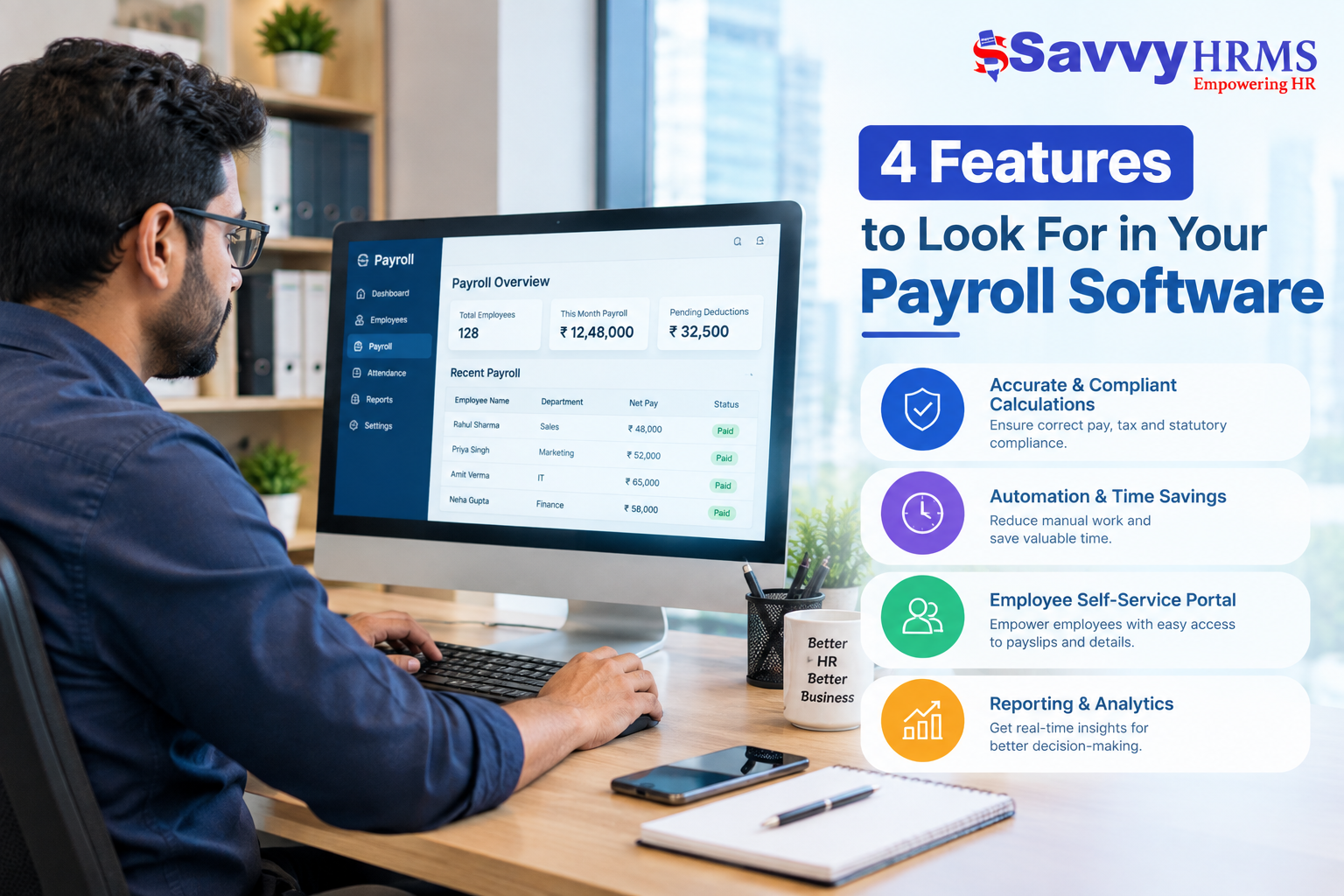
Here are four important features to look for when selecting payroll software.
1. Automated Salary Calculation
Salary calculation is one of the tasks handled by a payroll system. The software must be able to calculate employee salaries using the information in the system.
A good system can take into account salary components such as basic salary, allowances, deductions, overtime, bonuses and other payments that apply.
For example if an employee takes leave during a month, the system must be able to take into account the available leave information while calculating the salary.
Automated calculations can reduce the amount of manual work required by the payroll team. They can also reduce mistakes that may happen when calculations are done separately in spreadsheets.
This becomes even more useful when a company has hundreds or thousands of employees because calculating salaries manually for every employee can take considerable time.
2. Attendance and Leave Integration
Attendance and leave are closely connected with payroll.
Employees receive their monthly wages based on their work hours and their time off, additional work hours and their complete attendance records. The payroll staff needs to gather and verify this data before they can start processing employee payments.
A payroll software that integrates with attendance and leave data will simplify the process for users.
The attendance system shows the essential working days but the leave system displays officially approved leave records. The system generates data that organizations should use for their salary payment process.
The payroll team needs to input their data only once because it automatically transfers to subsequent systems without requiring additional manual data entry.
The process becomes faster through this system because it saves organizations which have many employees from handling their monthly payroll activities in an ordered way.
3. Support for Payroll Compliance
Payroll operations need more than salary number calculations to function correctly. Businesses must handle their payroll-related needs together with all required deductions that appear in their records.
Payroll consists of different elements that are determined by organizational and employee information.
- Provident Fund (PF)
- Employee State Insurance (ESI)
- Professional Tax
- Labour Welfare Fund (LWF)
- Tax Deducted at Source (TDS)
The software should help the payroll team manage the deductions that apply and keep the related records up to date.
Companies need to check that their payroll system meets all the requirements that are important to their business before they choose a payroll solution.
The software must be checked for updates every time the rules and requirements that affect it change. This process will help HR and payroll teams do their tasks more easily.
Software systems need human oversight to check compliance needs because these systems cannot perform the entire compliance process by themselves.
4. Payslip and Payroll Reports
Employees want to know how their monthly salary has been calculated. The payroll system needs to generate payslips which employees should receive through an efficient delivery method.
A payslip contains essential details which include employee earnings together with all deduction amounts and the final amount they receive as net salary.When payslips are generated directly from the payroll data, HR teams do not need to prepare them manually for every employee.
Reports are also useful for HR teams and management.
Depending on the system, businesses may be able to generate reports related to:
- Employee salary details
- Earnings and deductions
- Attendance and leave
- Statutory deductions
- Tax information
- Department-wise salary
- Monthly payroll records
Having these reports in one place can make it easier to review payroll information and find specific records when required.
Why Should Payroll Be Connected With Other HR Processes?
Payroll functions as an independent system which does not connect with other systems. The system collects its data from different HR operations which operate independently from each other.
The process of salary payment is affected by employee information together with their work attendance, vacation time and other documentation they provide. HR teams need to transfer data between different systems because they operate their systems independently from each other.
The integration of payroll systems with other HR functions drives Indian businesses to adopt HR software solutions that combine these elements.
A single HR system that integrates various HR functions enables businesses to manage their employees through one platform which includes attendance and leave tracking, payroll processing and other HR-related activities.
The payroll department obtains employee attendance data through system integration with their approved leave records which eliminates their need to enter information manually during payroll processing.
How Can a Payroll System Help HR Teams?
Payroll processing involves many repeated tasks every month. When employee information is spread across different files, checking and updating records can become difficult.
A digital payroll system can bring important information together and make the process easier.
It can help HR teams:
- Reduce manual calculations
- Save time during salary processing
- Reduce repeated data entry
- Keep employee salary records organized
- Generate payslips more easily
- Access payroll reports
- Give employees easier access to salary information
- Manage payroll information in one place
These benefits can become more important as the workforce grows.
Conclusion:
Overall, the selection of proper Payroll Software enables HR and payroll staff to perform their salary processing duties through a single interface. Businesses can manage their calculation tasks, attendance tracking, leave management, deduction processing, payslip generation and report creation through a single unified system instead of handling these activities separately in different files.
The system needs to have four essential features which include automated salary calculation and attendance and leave tracking, compliance support and payslip generation with reporting capabilities.
Businesses that require complete HR management solutions should explore HR software in India that links payroll operations with employee management systems, attendance tracking and leave management, performance evaluation and additional HR functions. Your business needs a solution that works well with your staff while keeping your information safe and providing growth potential for your business.
Simplify Payroll With Savvy HRMS
Looking to make your salary process easier?
Savvy HRMS helps organizations manage employee information, attendance, leave, payroll, and other HR activities through one integrated platform.
Book your free demo today and discover how Savvy HRMS can make payroll and HR management easier.