Introduction
Mumbai’s real estate is famously vertical — high-rise residential towers, packed commercial complexes, and premium societies where thousands of people move through shared lifts every single day. It’s a city built for a format like elevator advertising, which is exactly why demand for a reliable lift advertising company in Mumbai has grown steadily as brands look for ways to stand out beyond the city’s crowded billboard and digital ad space.
This guide covers what actually matters when evaluating lift advertising as part of your marketing plan in Mumbai and Navi Mumbai.
The Main Issue: High Density Doesn’t Automatically Mean High Impact
It’s tempting to assume that because Mumbai buildings are packed with residents, any lift ad placement will perform well. In practice, density alone doesn’t guarantee results — a poorly targeted placement in the wrong building type, or generic creative that doesn’t account for Mumbai’s fast-paced, high-clutter advertising environment, can easily underperform despite high footfall.
The real opportunity in Mumbai lies in precision: choosing the right buildings for your specific audience, not simply the tallest or busiest ones.
Key Considerations Before Booking
- Island city vs. suburbs vs. Navi Mumbai — these are functionally different markets with different income profiles, commute patterns, and building types
- Premium vs. mass-market societies — South Mumbai and Bandra-format premium towers require different creative and messaging than suburban mass-housing societies
- Commute-heavy audiences — many Mumbai residents are in and out early for long commutes, so ad visibility windows and creative simplicity matter more here than in less commute-intensive cities
- Space constraints — Mumbai lifts, especially in older buildings, are often smaller, which affects poster sizing and digital screen placement options
- Monsoon planning — outdoor and building-entrance advertising can be disrupted during Mumbai’s monsoon months, making indoor lift placements a more consistent option for that period
Practical Guidance: Choosing the Right Approach
- Map your target audience to specific localities first — Andheri, Powai, Thane, and Navi Mumbai each have distinct demographic profiles worth targeting separately rather than as one block.
- Ask potential agencies for their actual Mumbai and Navi Mumbai site list. A genuine lift branding agency in Navi Mumbai should be able to name specific societies or commercial complexes, not just claim broad city coverage.
- Keep creative simple and high-contrast. Mumbai audiences are used to a high volume of advertising; a cluttered lift poster gets ignored quickly.
- Clarify screen-sharing terms for digital placements. If your ad rotates with others on a digital lift screen, ask how many advertisers share the slot and how often your creative appears.
- Factor in approval timelines for co-operative housing societies, which in Mumbai often require formal managing committee sign-off before external advertising is permitted.
Common Mistakes Brands Make
- Targeting “Mumbai” broadly instead of specific zones that actually match the product or service being advertised
- Using text-heavy creative that doesn’t work in the brief viewing window of a typical Mumbai lift ride
- Ignoring Navi Mumbai and Thane as separate markets with their own growing residential base, rather than treating them as an extension of South Mumbai
- Not confirming monsoon-proof installation for physical posters, which can degrade quickly in humid conditions if not properly laminated or protected
- Choosing agencies based on lowest quoted price alone, without verifying actual building quality or footfall
When Professional Help May Be Useful
Mumbai’s building density, co-operative housing society processes, and zone-by-zone audience variation make it a market where local expertise genuinely pays off. An established lift advertising company in Mumbai — one with real experience navigating housing society approvals and knowledge of which buildings suit which type of campaign — can save significant time compared to approaching individual societies directly.
This is especially useful for brands unfamiliar with Mumbai’s specific co-operative society dynamics, which differ in process and pace from other Indian cities.
Conclusion
Mumbai offers genuine opportunity for elevator advertising, but its scale and complexity reward precision over volume. Choosing the right zones, respecting the city’s fast-moving, high-clutter advertising environment, and working with a partner who understands local society approval processes will consistently outperform a scattershot approach across the whole city.
Before booking a campaign, get specific about which Mumbai neighbourhoods actually match your audience — that decision matters more than almost anything else in this market.
Frequently Asked Questions
- What are the top 10 advertising agencies in Mumbai?
Mumbai is headquarters to many of India’s leading agencies, including Ogilvy, Lowe Lintas, Dentsu, JWT/VML, McCann Worldgroup, FCB Interface, Leo Burnett, Publicis, Havas, and several specialist out-of-home and digital agencies.
- What are the top 10 elevator companies in Mumbai?
Major elevator manufacturers and installers operating in Mumbai include Otis, Schindler, KONE, Johnson Lifts, Mitsubishi Electric, ThyssenKrupp, Fujitec, and several regional installers — distinct from lift advertising companies, which place ads inside existing elevators rather than manufacturing them.
- What is a lift in advertising?
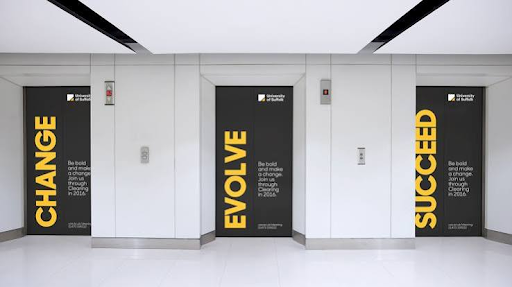
In advertising, a “lift” refers to the elevator car itself, used as an enclosed ad space where posters, digital screens, or door wraps are displayed to passengers during their ride.
- Who are the big 5 advertising agencies?
Globally, the five largest advertising holding companies are typically considered WPP, Omnicom, Publicis Groupe, Interpublic Group (IPG), and Dentsu.
- Is lift advertising effective in Mumbai’s high-rise buildings?
Yes, particularly in buildings with consistent daily footfall — the confined, repeated-exposure nature of lift rides works well in Mumbai’s high-density residential and commercial towers.
- How is lift advertising different in Navi Mumbai compared to South Mumbai?
Navi Mumbai tends to have newer, larger residential complexes with younger family demographics, while South Mumbai skews toward older, established, higher-income buildings — creative and targeting should reflect these differences.
- Can lift advertising work for real estate brands in Mumbai?
Yes, it’s a strong fit — placing ads in nearby or comparable residential towers puts a project directly in front of an audience already living in relevant property types.
- Do Mumbai housing societies charge for allowing lift advertising?
Many societies receive a share of advertising revenue or a placement fee as part of the agreement, which is typically negotiated and handled by the advertising agency on the brand’s behalf.
- What format works best for small lifts common in older Mumbai buildings?
Compact posters or smaller digital panels tend to work better than large-format displays in older buildings with smaller lift cars, where space is limited.
- How long does it take to launch a lift advertising campaign in Mumbai?
Typically 1–3 weeks from agency selection to launch, depending on how quickly housing society or building management approvals are secured.
Contact LiftUp Marketing to explore lift advertising options across Mumbai and Navi Mumbai: www.liftupmarketing.in


